


Syllabus: GS3/ Economy/ Defence
Context
- At the National Defence Industries Conclave (2026), Defence Minister of India has emphasised that India must develop a self-reliant drone manufacturing ecosystem to strengthen its defence preparedness.
About
- An unmanned aerial vehicle (UAV) or unmanned aircraft system (UAS), commonly known as a drone, is an aircraft with no human pilot, crew, or passengers on board, but rather is controlled remotely or is autonomous.
- According to industry estimates, the global drone market is valued at over $30 billion in 2025 and is projected to reach $90–100 billion by 2030, driven by rapid adoption of AI, automation, and 5G integration.
- Drone Ecosystem in India:
- As of February 2026, India has built a regulated drone ecosystem with 38,500+ registered drones (UIN), 39,890 DGCA-certified remote pilots, and 244 approved training organisations.
- Drones are Integrated into flagship government schemes in India such as Survey of Villages and Mapping with Improvised Technology in Village Areas (SVAMITVA) and Pradhan Mantri Fasal Bima Yojana (PMFBY) etc.
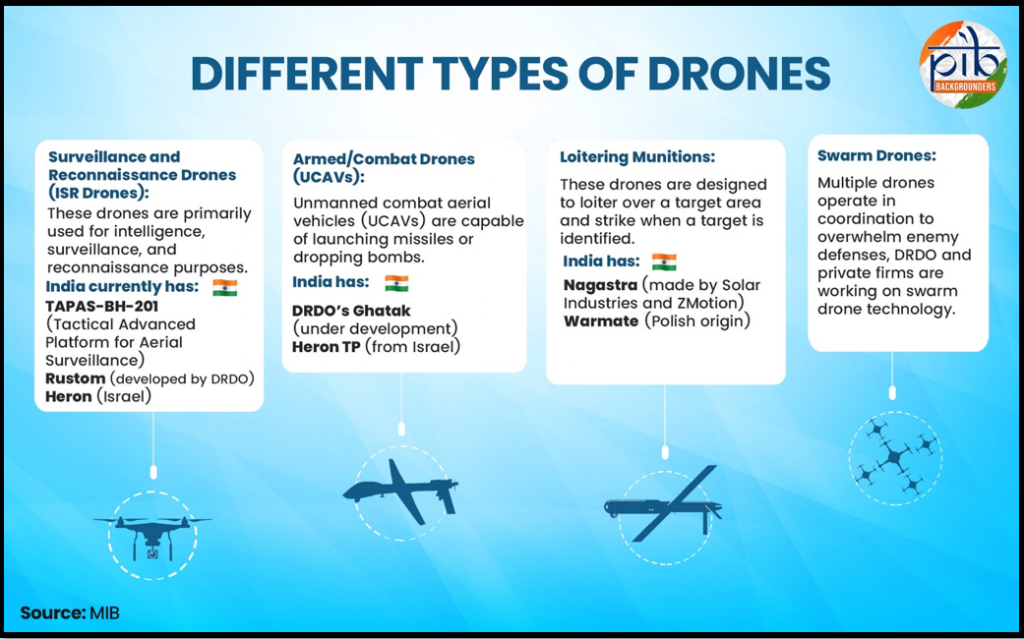
Why Drones are Central to Modern Warfare
- Tactical Superiority: Drones provide high-precision strike capabilities, enabling targeted operations with minimal collateral damage.
- They significantly reduce risks to human life by eliminating the need for direct troop engagement in high-risk zones.
- Surveillance & Intelligence: Drones play a critical role in Intelligence, Surveillance, and Reconnaissance (ISR) operations by providing real-time data and situational awareness.
- Asymmetric Warfare Tool: Drones have emerged as a powerful tool for asymmetric warfare, allowing weaker states and non-state actors to challenge technologically superior adversaries.
- Strategic Rationale: Achieving self-reliance in drone manufacturing is essential to ensure strategic autonomy and national security, particularly during geopolitical crises.
Government Initiatives in Drone Sector
- Drones Rules, 2021 provide the necessary regulatory framework for commercial use of drones.
- These rules cover various aspects like type certification, registration and operation of drones, airspace restrictions, research, development and testing of drones, training and licensing, offences and penalties etc.
- Drone Airspace Map published in 2021, has opened nearly 90% of Indian airspace as a green zone for drones flying up to 400 feet.
- Production-Linked Incentive (PLI) scheme provides for an incentive of Rs 120 crores, spread over three financial years. The PLI rate is 20% of the value addition over three financial years.
- Drone certification scheme 2022, making it easier to obtain type certificates by drone manufacturers.
- Drone import policy 2022, banning import of foreign drones and freeing up import of drone components.
- Drone (Amendment) Rules, 2022 abolished the requirement of a drone pilot license.
- GST on drones: GST on drones was reduced to a uniform 5% in September 2025. Earlier tax rates of 18% and 28% were removed. This simplified taxation supports wider commercial and personal use of drones.
Key Challenges in Drone Manufacturing
- Dependence on Critical Components: India remains dependent on imports for key components such as semiconductors, high-resolution sensors, and advanced propulsion systems.
- Global supply chains are concentrated in a few countries, creating strategic vulnerabilities.
- Technological Gaps: There exist capability gaps in areas such as:
- AI-driven autonomous navigation systems.
- Advanced materials and miniaturisation technologies.
- Secure communication and anti-jamming systems.
- Regulatory Ecosystem: The absence of a fully developed ecosystem for testing, certification, and airspace integration poses challenges to rapid innovation.
Way Ahead
- The government should promote defence innovation through funding support, incubation centres, and dedicated defence corridors.
- Simplification of procurement procedures and faster decision-making are necessary to attract private investment.
- India must invest in advanced counter-drone systems, including electronic warfare and directed energy weapons.
Concluding remarks
- The increasing centrality of drones in modern warfare has fundamentally altered the nature of conflict, making technology a decisive factor in military outcomes.
- India’s pursuit of self-reliance in drone manufacturing is therefore not merely an economic objective but a strategic necessity to ensure national security, technological sovereignty, and long-term defence preparedness in an evolving global security environment.
Source: TH
Previous article
News In Short 19-03-2026
